Metadata
aliases: []
shorthands: {}
created: 2022-02-27 22:42:31
modified: 2022-02-27 23:03:45
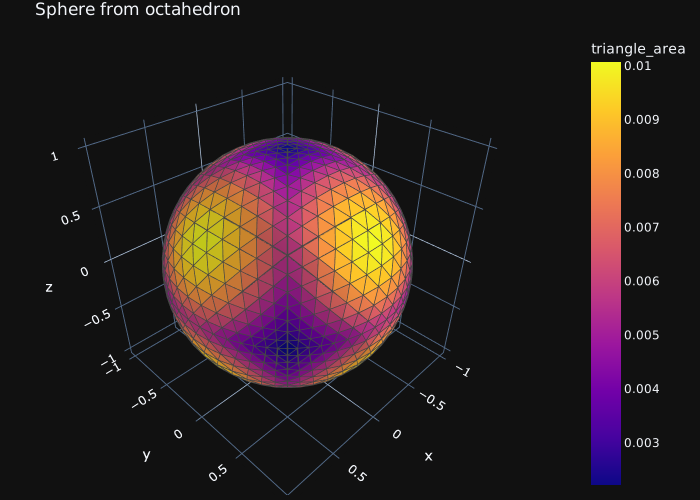
A good way of generating a sphere mesh is to start out from a regular shape
The result of the method is shown by the following figure with
The ratio of areas between the largest and smallest triangle on the mesh:
The example codes are written in Python and use the separate arrays convention for storing triangle meshes.
This function, generate_octahedron just gives a hardcoded octahedron mesh:
def generate_octahedron(r = 1):
    x = [0, 0, 1, 1, -1, -1]
    y = [0, 0, 1, -1, 1, -1]
    z = [1, -1, 0, 0, 0, 0]
    for n in range(len(x)):
        R = np.sqrt(x[n]**2 + y[n]**2 + z[n]**2)
        x[n] = x[n]/R
        y[n] = y[n]/R
        z[n] = z[n]/R
    i = [0, 0, 0, 0, 1, 1, 1, 1]
    j = [2, 2, 3, 4, 2, 2, 3, 4]
    k = [3, 4, 5, 5, 3, 4, 5, 5]
    return x, y, z, i, j, k
The result of this is this octahedron:
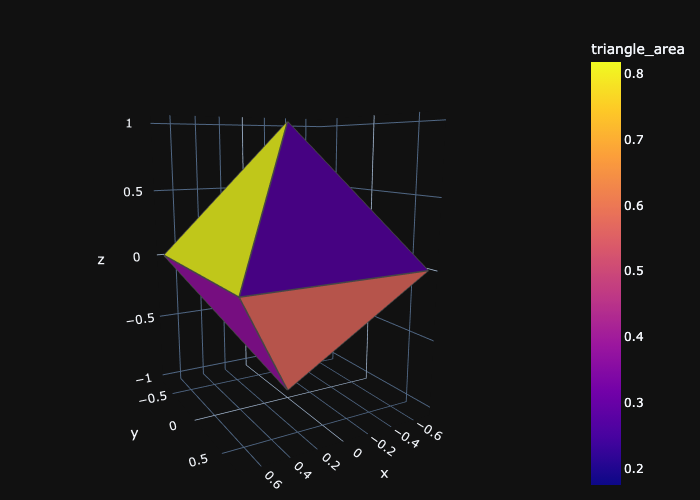
Then with the shown function and the subdivide_triangles function from here, we can give the mesh extra vertices. Finally, by projecting these vertices to a sphere, we get the final result.
x, y, z, i, j, k = generate_octahedron(1)
x, y, z, i, j, k = subdivide_triangles(x, y, z, i, j, k, 4)
for n in range(len(x)):
        R = np.sqrt(x[n]**2 + y[n]**2 + z[n]**2)
        x[n] = x[n]/R
        y[n] = y[n]/R
        z[n] = z[n]/R
So the final result is the first figure on the page.